
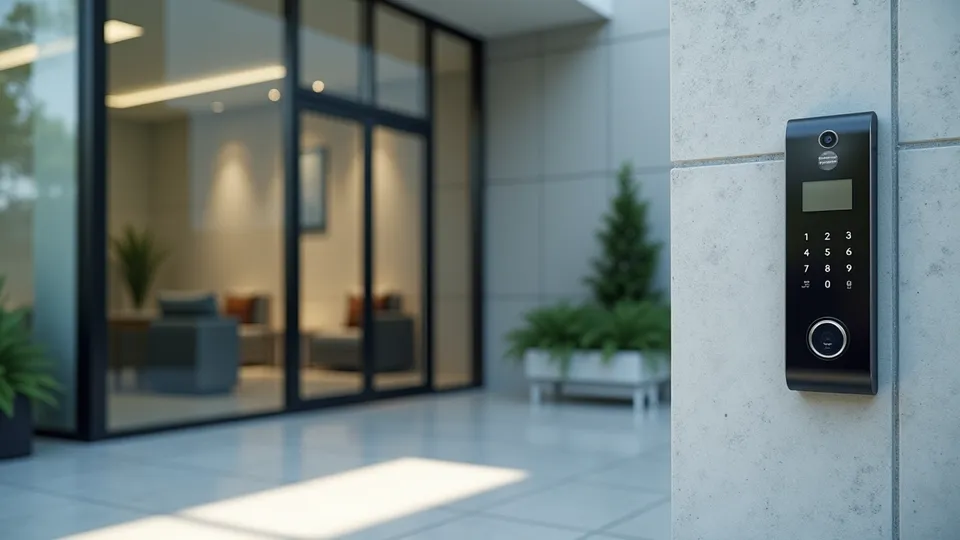
Most New Hampshire property owners who search for access control systems for apartment buildings already know why they are looking. A tenant moved out and kept the keys. Someone is propping the rear common door with a fold-up chair. The laundry room lock has been “temporary” for two years. The decision to move off mechanical keys is easy. The hard part is choosing which system actually fits your building, because the right answer for a six-unit triple-decker in Manchester is not the right answer for a ninety-unit complex in Nashua or Salem.
This guide breaks down the main system types, what each does well, and the New England-specific realities — winter hardware, power outages, turnover math — that should drive the choice. Arcomm has been designing and installing these systems for NH multifamily buildings since 1985, and this is the same evaluation we walk through with owners on site walks.
What access control actually covers in an apartment building
The first mistake owners make is treating access control as a front-door-only purchase. In a multifamily building, credentials and entry control touch more doors than you think:
- The main entrance — where visitors, deliveries, and tenants all converge
- Rear and side common doors — the ones that get propped open because nobody wants to walk around front
- Laundry, storage, and mechanical rooms — where a shared key on a pegboard defeats the point of anything
- Parking gates and garage doors — a seasonal headache in New Hampshire you will read more about below
- Elevator control — in larger buildings, restricting floors to residents of those floors
A well-scoped apartment building access control system covers the doors where risk and annoyance actually occur, not just the front entrance. Under-scoping is how owners end up with a secure front door and a wide-open back door two months later.
The main system types — and what building each one fits
Video intercom entry (Aiphone, 2N)
A video intercom replaces the buzzer box with a door station that connects to tenants’ phones. A visitor rings the unit, the tenant sees who it is, and releases the door from wherever they are — or denies it and watches the person walk away. Arcomm installs Aiphone and 2N systems, both built for exactly this use.
Fits best: any building where the core problem is front-door screening. If your pain is delivery drivers, guests, or strangers walking in behind tenants, a video intercom is the single highest-value upgrade. Larger 2N systems add directory code entry and relay control for gates and garages.
Fob and card credential systems
Each tenant gets a fob or card. You issue, revoke, and reassign credentials in software instead of calling locksmiths for rekeys. Common doors, laundry rooms, and garages get their own access levels — a tenant’s fob opens their building entrance but not the mechanical room.
Fits best: buildings of roughly eight units and up, or any building with shared interior spaces worth protecting. The payoff shows up at turnover: deactivate the credential, activate the new one, done. No rekeying, no key copies floating around Manchester in a former tenant’s desk drawer.
Cloud and mobile credentials
The management panel lives in the cloud instead of a closet server, and tenants can unlock doors with their phones. Owners who manage several buildings in different towns see every door, every event, and every credential from one login instead of driving building to building.
Fits best: owners and property managers with multiple buildings, and buildings where tenants keep losing fobs. Losing a phone is annoying; losing a phone that is also your building key means deactivating one credential and issuing a new one — a two-minute fix, not a locksmith call.
Integrated systems: access plus cameras plus intrusion
Access control reaches full value when it talks to the rest of the security stack. An entry event paired with a Hanwha or Axis camera snapshot answers “who used that credential at 11 PM” without guesswork. Bosch intrusion protection on mechanical and storage rooms means an after-hours door-forced event triggers the alarm instead of being discovered next month.
Fits best: larger complexes, buildings with repeated incident history, and any owner tired of three separate systems that know nothing about each other.
New England puts extra demands on this hardware
An access control configuration written for a mild climate fails here, usually in its second winter. Four regional realities to plan for:
- Cold weather on exterior hardware. Readers and door stations mounted outside need hardware rated for freezing operation, ice, and driving sleet. Consumer-grade units fog, fail, and drop reads exactly when your tenants are standing in a January doorway waiting for the door to open.
- Snow and gates. A parking gate that works beautifully in April gets defeated by a December plow pile, either physically or because the vehicle loop sensor ices over. Gate placement and sensor choices matter more here than nearly anywhere else.
- Power outages. New Hampshire storms take lines down. Battery backup keeps the system alive, and fail-secure settings decide which doors stay locked when power is gone. Cellular backup for connected systems keeps remote management and notifications working when the internet line is cut or down.
- Coastal corrosion. Seacoast buildings from Portsmouth to Hampton eat standard hardware with salt air. Marine-rated or stainless faceplates extend equipment life significantly.
If a contractor’s proposal does not mention any of these, the quote was written for somewhere else.
The turnover math that changes the decision
There is no honest single cost figure that fits every building, so we will not invent one. What every NH owner can price locally is the alternative: locksmith calls for rekeys and lockouts, hardware wear on mechanical locks that get hammered ten times a day, and the unpriced risk that a former tenant’s key copy is still in circulation somewhere. Credential-based systems collapse the first two into an occasional software task and eliminate the third entirely. Over a building’s life, that turnover math — not the sticker price — is what separates the system types.
Matching the system to the building
A starting matrix we use on site walks:
- 2 to 8 units: a quality video intercom at the main entrance, credentials on the rear common door if it gets abused
- 9 to 30 units: cloud-managed fob or mobile credentials across common doors plus a video intercom — the sweet spot for most NH multifamily owners
- 30 units and up: a layered design — gate control, elevator or floor restrictions, camera coverage tied to access events, and intrusion protection on mechanical spaces
Get a system designed for your building, not a catalogue kit
Arcomm has designed and installed apartment building access control across New Hampshire since 1985 — Aiphone and 2N intercoms, credential systems, camera integration with Hanwha and Axis, and Bosch intrusion protection, all specified for New England winters. We will walk your building, watch how tenants and deliveries actually move through it, and tell you honestly which system type fits — and what it will not fix.
Contact Arcomm at (603) 464-4000 or request a consultation.
Need help with this?
Arcomm has been installing and servicing commercial security and IT systems in New Hampshire since 1985. We'll tell you honestly what fits your building and budget.
Request a Consultation