
Property managers in New Hampshire face a security problem that does not have a good solution with traditional lock-and-key systems. When a tenant moves out, you collect their keys, if they hand them all back. You rekey the unit, if you caught it before the new tenant moved in. You hope the former tenant did not make copies. You change the locks again if they did.
This is not a hypothetical concern. It is the most common service call we get from apartment building owners in Manchester, Nashua, and Concord. Someone is locked out. Someone else has a key they should not have. The cycle costs $200–$500 per incident in labor and hardware. Multiply by tenant turnover in a 20-unit building and you are spending thousands annually on a problem that access control solves permanently.
The cost problem with mechanical keys in apartment buildings
A standard cylinder lock in a multi-unit building wears out faster than you think. Each rekey job runs $150–$250 per unit. When you factor in:
- Turnover rate: New Hampshire multifamily units average 20–25% annual turnover
- After-hours emergency calls: $150–$300 per visit
- Lock replacement after reported lost keys: $200–$400 per door
- Time spent managing key returns, tracking who has which key
The true annual cost of mechanical locks in a 20-unit building is often $4,000–$8,000. That is before you account for the security liability when a former tenant refuses to return keys or claims they made copies.
A cloud-managed access control system with per-unit credential control costs $2,800–$6,500 to install in a 20-unit building. Annual software licensing runs $600–$1,200. The credential management is instant, a tenant move-out takes 30 seconds, not a service call.
What a modern apartment building access control system looks like
A complete system for a New Hampshire apartment building typically has three layers:
1. Building entrance control
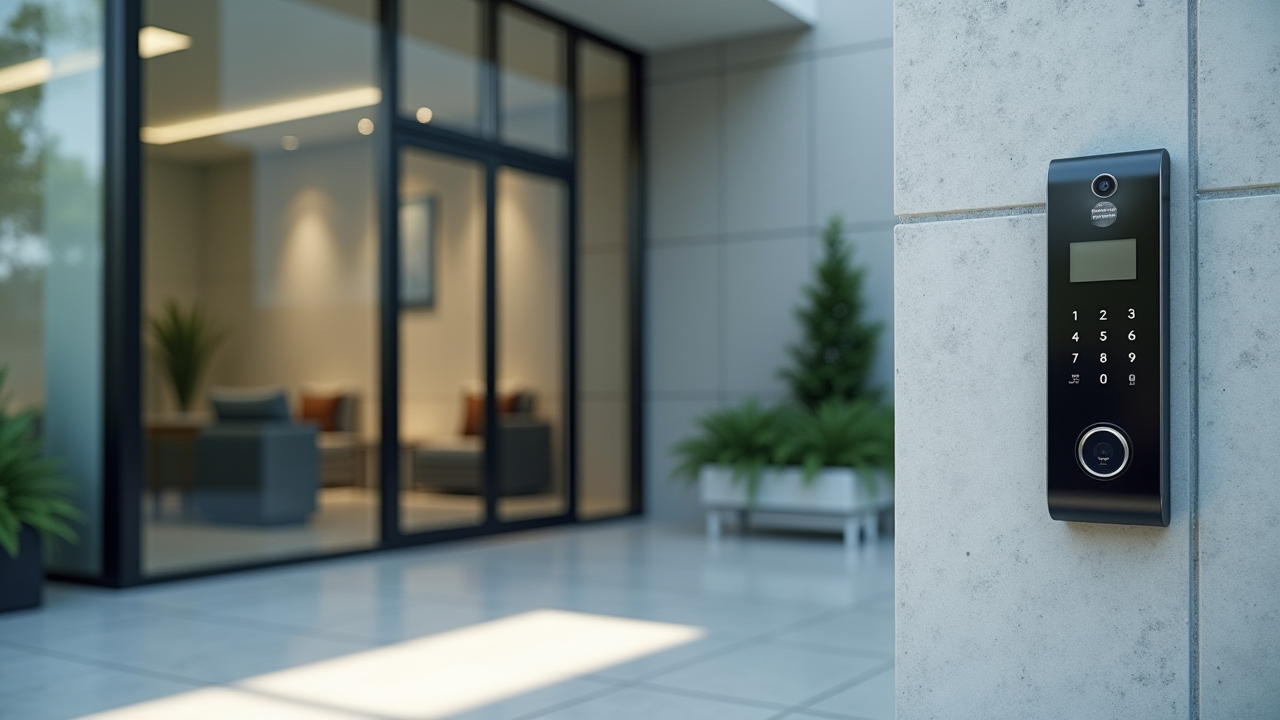
The main entrance needs a video intercom so visitors can announce themselves to units. The tenant can see who is at the door and buzz them in remotely from their phone. This eliminates the need for a central concierge desk during off-hours. We install Aiphone and 2N systems for this, the Aiphone IX Series handles high-traffic apartment buildings well; the 2N IP Force units work for buildings that want tighter integration with the access control platform.
2. Common area access
Hallways, stairwells, amenity spaces, and parking garages get proximity card readers or keypad readers. Tenants use a fob or card, no one needs a physical key for any common area door. If a fob is lost, you deactivate it in the cloud console and issue a new one. The deactivated fob is worthless to anyone who finds it or keeps it after moving out.
3. Unit entry (optional)
Some buildings run access control all the way to the apartment door. This is more expensive, $400–$800 per unit for a complete wired reader, lock, and panel, but it eliminates unit keys entirely. For high-end apartment buildings in Portsmouth, Dover, and Lebanon where rents support the infrastructure, it is worth considering. For most market-rate buildings in central New Hampshire, common area control is sufficient.
The credential management advantage
Here is the feature property managers care about most once the system is installed: centralized credential management.
When a tenant signs a lease, you issue them a fob or card and activate it in the access control software. When they move out, you deactivate it. There is no physical key to collect. There is no rekeying. There is no arguing about whether they gave back every copy.
If a tenant reports a lost fob at 9 PM on a Friday, you log into the cloud portal, deactivate that credential, and issue a new fob on Monday morning. The lost fob is dead the moment you click a button.
This applies to staff credentials too. When a maintenance worker leaves, their building access is revoked in under a minute. When a cleaning crew’s contract ends, their common area access stops the same day.
Brands we install for apartment buildings
For New Hampshire apartment buildings, we typically specify:
- Brivo for cloud-managed systems where the property manager handles credentials from a laptop or phone
- Aiphone for video intercom entrances, the JKB-36DSP is a common spec for multifamily buildings
- Keyscan for buildings that want on-premise controllers rather than cloud management
- Bosch for per-unit intrusion panels where the building wants alarm monitoring as a service
We do not sell residential-grade smart locks for apartment unit entries. Commercial-grade access hardware handles the traffic and wear that a multifamily building generates.
The fire code compliance question
New Hampshire fire marshals require that electronically locked doors in commercial apartment buildings release on fire alarm activation. This means any access control system you install must have a fire alarm relay input that cuts power to the locks automatically when the fire system activates.
Standalone keypad locks and residential-grade smart locks typically do not have this input. They may not pass inspection in a commercial building. We wire every commercial access control installation with fire alarm integration as standard, this is not an add-on for us, it is how the system is designed from day one.
Manchester and Nashua fire inspectors have flagged this specifically during certificate of occupancy inspections. If you are installing access control in a commercial apartment building, ask your contractor about fire alarm relay integration before signing a proposal.
What it costs in New Hampshire
Access control installation for a 20-unit apartment building in New Hampshire typically breaks down as:
- Main entrance video intercom with directory: $3,500–$6,500
- Common area readers and controller (10 doors): $8,000–$14,000
- Per-unit alarm panels (optional): $3,000–$6,000
- Annual cloud software licensing: $600–$1,200
Total installed cost for a complete common-area system: $12,000–$22,000. Per-unit alarm integration adds $3,000–$6,000 depending on the building layout.
Compare that to the annual cost of mechanical rekeying, emergency lockouts, and key management: in a building with two turnover events per year and 20 units, mechanical locks typically cost $5,000–$8,000 annually. Access control pays for itself within three to four years in most scenarios.
The property management software question
If you run your building through Property Management Software (RentManager, AppFolio, Buildium, Yardi), you already know how much time goes into onboarding and offboarding tenants. Access control credential management integrates cleanly with those workflows, Brivo in particular has direct integrations with major property management platforms.
This means when you mark a lease as terminated in your property management system, you can trigger the credential deactivation in the access control system automatically. No manual steps. No forgotten deactivations. No security gap because the person handling move-out was on vacation.
We help property managers set up these integrations as part of the installation. It is not something you figure out after the hardware is in, we design for it from the beginning.
Is access control right for your building?
Access control makes sense for:
- Buildings with more than 8 units where turnover happens regularly
- Buildings where the owner or manager handles credential management remotely
- New constructions where you are running low-voltage cable anyway
- Buildings with amenity spaces (gym, roof deck, parking) that need per-user access rules
It is probably overkill for:
- A 4-unit residential property where the owner knows every tenant personally
- Short-term rentals where you are rekeying for every new guest anyway
- Historic buildings where running cable is cost-prohibitive
If you are not sure whether your building is a good candidate, we will look at it honestly. We have installed access control systems in apartment buildings in Manchester, Dover, Portsmouth, Concord, and Lebanon. We will tell you if mechanical locks are the smarter move for your situation.
Contact Arcomm at (603) 464-4000 or request a consultation to discuss access control for your New Hampshire apartment building.
Need help with this?
Arcomm has been installing and servicing commercial security and IT systems in New Hampshire since 1985. We'll tell you honestly what fits your building and budget.
Request a Consultation